Cappadocia, one of the places where nature and history are most beautifully integrated in the world, is a historical region bordered by Aksaray, Niğde and Kayseri districts of Central Anatolia and the center of which is Nevşehir Ürgüp. The traces of thousands of years old civilizations created by people who built houses, churches and underground cities by processing the unique geography created by the volcanic eruptions formed millions of years ago have reached today as a great heritage.
With this unique structure, Cappadocia is the most visually striking region of Turkey and has become one of the world-famous tourist destinations with its fairy chimneys, churches-monasteries carved into soft volcanic rocks, underground cities as well as magnificent valleys. The most visited regions in Cappadocia are the narrower rocky Ürgüp, Göreme, Uçhisar, Avanos, Derinkuyu, Kaymaklı, Ihlara and its surroundings.
Geological Features of Cappadocia

The geology of Cappadocia has been a very challenging field for geologists, with its formations created by complex and sequential volcanic events that took place over millions of years. Contrary to what is commonly known, igneous rocks, generally composed of ignimbrites, volcanic ash, lavas and volcano-sedimentary units, formed by volcanoes much older than Hasandağ, Melendiz, Aladağlar and Erciyas, which are relatively young volcanic mountains, over ten million years They covered an area of more than twenty thousand km square and were deposited in the basin. It is known that the last volcanic eruption took place on Mount Erciyas two and a half million years ago.
When the natural forces of wind and water (erosion) did their job, fairy chimneys and unique valleys that we see today and stretching up to forty meters into the sky were formed on volcanic formations. However, it was human intelligence alongside nature that gave Cappadocia its magical aesthetic. During the Roman period, persecuted Christians fled to Cappadocia, most heavily to the town of Göreme, and when they soon realized that tuff was a useful, workable material, they started to build a network of handmade caves, living quarters, churches, barns and warehouses dug into these soft rocks. Today, a honeycomb web of handcrafted rocks still contains traces of past lives; barns with handles used to bind animals, perforated walls for air circulation, and blackened walls that were once kitchens.
History of Cappadocia
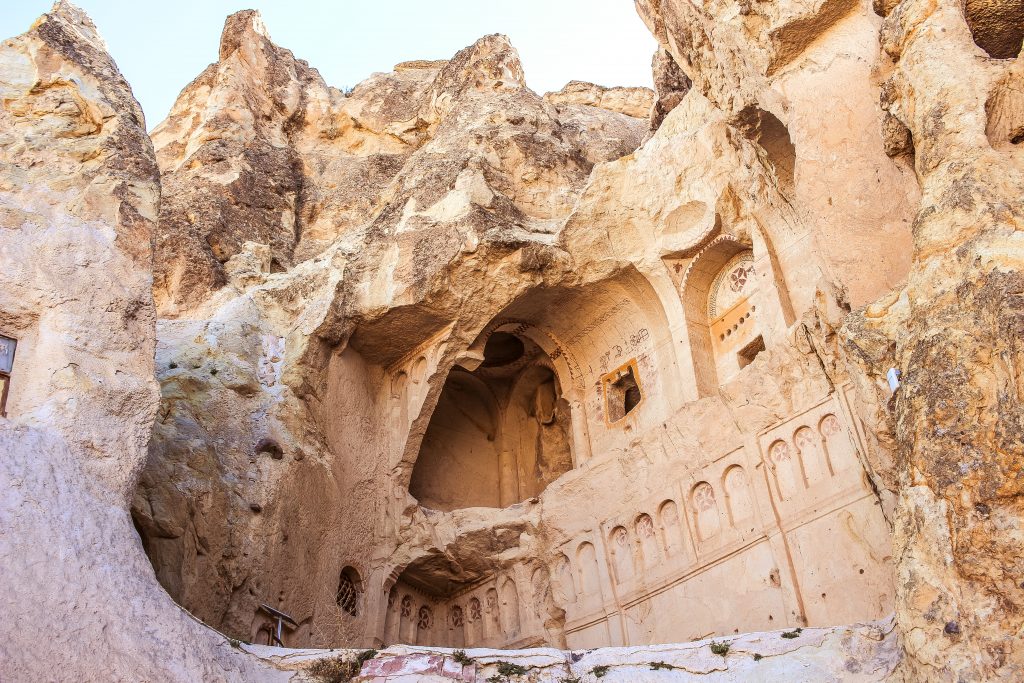
Human settlement in Cappadocia dates back to the Paleolithic period. It was understood that the volcanoes that became active again after this period did not allow human settlement for a long time, and that with the discovery of obsidian and silex stone tools, which were found to belong to the Neolithic period during the archaeological excavations on Avla Hill near Ürgüp, life began again in this period.
The oldest civilization known in the history of Cappadocia is the civilization created by the Assyrians between 3000 BC and 1750 BC. The Assyrians established their first commercial organizations in Kayseri Küllütepe and Hattusa Karum, which are the market places. The use of writing in Anatolia was during the Assyrian period, and in the ancient cuneiform texts, known as the Cappadocia tablets, there were articles regulated like a law related to trade and marriage. The Assyrians laid the foundation of the Hittite civilization that would later be established, brought their worship and god ideas to Anatolia, and combined the existing understanding of art with Mesopotamian art.
After the Assyrians, the Hittites, who came from Europe through the Caucasus, entered the history of Cappadocia, between 1750 and 700 BC, they established a civilization that lasted long enough to leave their traces almost everywhere in the region. The capital of the Hittites, which turned into a great empire, was Hattusha, and its important cities were Alişar and Alacahöyük. The dates when the underground cities of Cappadocia were laid with secret passages for defense also coincide with the Hittite period. Narrow corridors, huge stones closing the corridors, ventilation were developed by the Hittites.
With the Phrygians appearing on the scene in the history of Cappadocia, the Hittite cities in Central Anatolia were destroyed one by one and the Late Hittite period began in Central and Southeastern Anatolia in 1200 BC. The Late Hittites, who ruled in the Cappadocia region, turned into the Tabal Kingdom, which included Kayseri-Niğde-Nevşehir. The hieroglyphic rock monuments of this period are located in Gökçetoprak, Hacıbektaş Karaburna Village and Acıgül. Late Hittite period lasted until the Persian invasion in the 6th century BC.
Alexander the Great, the king of the Ancient Macedonian Kingdom between 336 and 323 BC, defeated the Persians in 332 BC and ended the Persian domination, but faced great resistance in Cappadocia. During this period, the Kingdom of Cappadocia was established, but towards the end of the third century BC, the power of the Romans began to be felt in the region. In the middle of the first century BC, the Kings of Cappadocia were appointed and deposed by the power of the Roman generals, and finally when the last King of Cappadocia died in 17 AD., the region became a province of Rome.
Christians came to Cappadocia in the third century AD and made the region a center of education and thought. When the pressures on the Christians increased, deep valleys and houses and churches carved into the soft volcanic rocks made the region a huge shelter for Christians fleeing the pressure of the Roman Empire, making Cappadocia an ideal place to protect themselves from oppression and to spread Christian doctrine.
The fourth century AD was the period of the priests called "Cappadocia Fathers" (Church Fathers) formed by the trio of Basil, his close friend Gregory of Nazianzus and his younger brother Gregory who are known as "The Great" in Western literature for their contributions to Christian theology,. During the "Cappadocia Fathers" period, the doctrines that formed the basis of Christianity were determined, and the region, which became more livable with clear and clear religious rules, began to receive more Christian immigration from outside.
The real population growth in the region took place at a time when Leon III (685-741 AD) banned icons as religious works of art. In this period, which lasted for more than a century and was called “Iconoclasm”, those who did not support the decision, thought that their religious values were interfered with and wanted to live their faith freely, migrated to Cappadocia and joined the life there. In this period, although a few Cappadocian churches were under the influence of Iconoclasm, those who favored the icon continued their worship easily and the Cappadocian monasteries developed considerably during this period.
Another event that took place during the Leon III period and the results of which affected Cappadocia was the Arab incursions into the Christian regions of Anatolia from Armenia to Cappadocia. The people who came to the region by escaping from these raids caused the styles of the churches in the region to change.
Cappadocia was conquered by the Seljuk Turks in the 11th and 12th centuries. The region had a trouble-free period under the rule of the Seljuks and later the Ottoman Empire. The last Christians in Cappadocia immigrated, leaving beautiful architectural examples behind, with the exchange made due to the Treaty of Lausanne in 1924-26, while some of the Turks living in the Balkans left their homes and settled in Cappadocia, like Christians with whom they shared a common destiny.
Architecture of Cappadocia
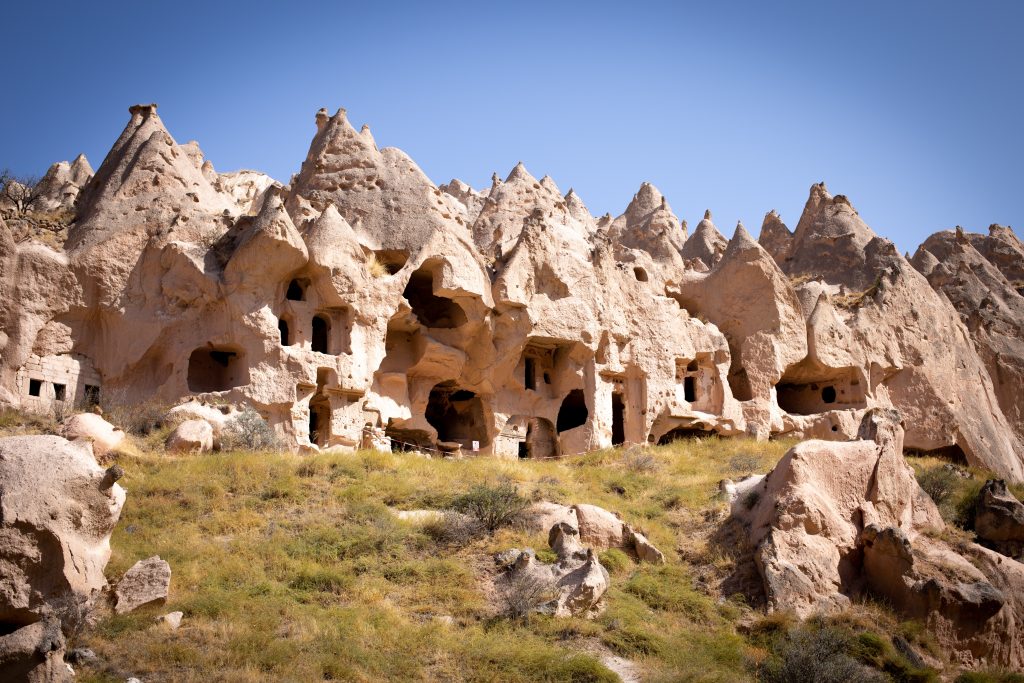
Traditional cave houses and dovecotes carved into the rocks in Cappadocia form an architectural structure with a unique and insatiable course. These houses were built in the 19th century on the slopes, into the rocks, or from cut stone.
Stone, which is the only architectural material of the region, can be processed very easily because it is soft after coming out of the quarry due to the volcanic structure of the region, but after contact with air, it hardens and turns into a very durable building material. Due to the abundance of the material used and its easy processing, stonework, which is unique to the region, has developed and become an architectural tradition.
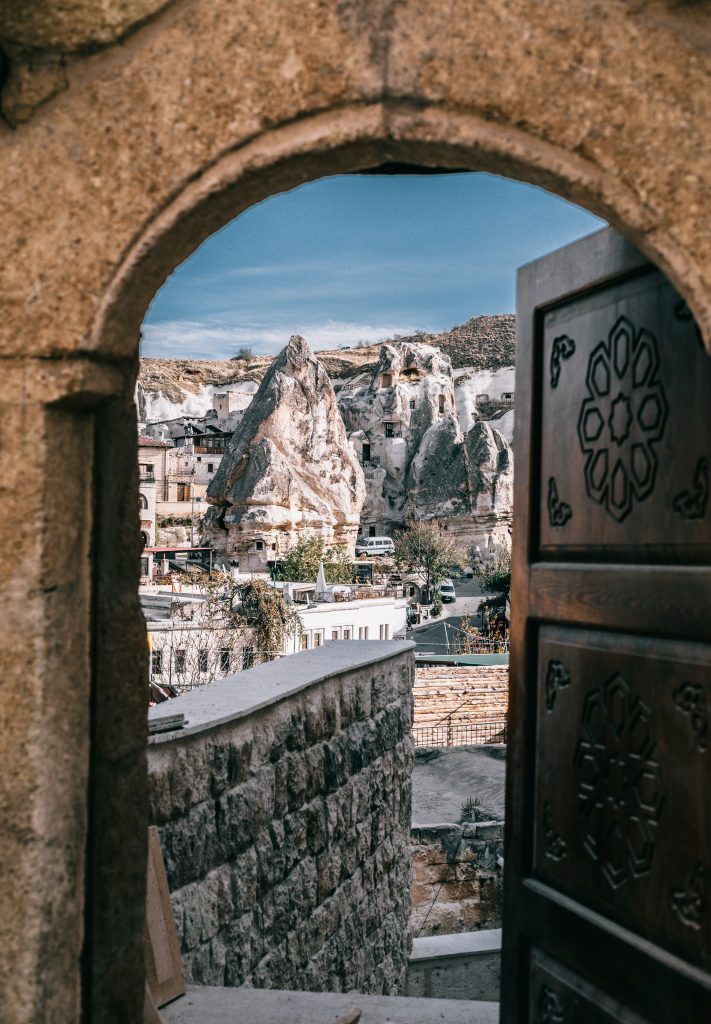
An arched, vaulted architectural structure is dominant in Cappadocia houses. Rooms are arranged around the courtyard. Wood was used in the construction of the courtyard and its doors. The doors are usually arched and their upper parts are decorated with stylized ivy or rosette motifs. The spaces between the consoles located between the floors of the houses are filled with rosettes, stars, fans, windmills and stylized plant motifs.
The windows of the houses are in two or three, and they are mostly decorated with stylized plant motifs. The windows are of two types, 'winged' and 'guillotine'. There are many rooms, kitchens, warehouses, tandoors and cellars in the houses. There are decorations painted on plaster in the niches in the guest rooms. Stone fireplaces, stone stairs, decorative niches, ottomans, local carpets, earthenware pots, objects are indispensable elements in their decoration.
The dovecotes in the region are small structures built in the late 19th and 18th centuries. Some of the dovecotes, which are important in terms of showing the art of Islamic painting, were built as monasteries or churches. The surface of the dovecotes is decorated with rich ornaments and inscriptions by local artists.
Agriculture in Cappadocia
With its mineral-rich soils, Cappadocia is perfect for growing vegetables and fruits and has made Cappadocia a rich agricultural region as well as being a tourism center. It has always been one of the most important grape growing regions in Anatolia and still has many productive vineyards and wineries.
Although it does not allow much diversification of agricultural products due to seasonal and precipitation conditions, extremely delicious sugar beet, wheat, barley, rye, broad beans, chickpeas, beans and lentils are grown in the region. Nevşehir is known throughout the country for its potato and pumpkin seed production.
Fruit growing, especially viticulture, has an important place in the agricultural economy of the region. As a fruit, very high quality and world-famous grapes, apples, pears, walnuts, plums, apricots, quinces, mulberries, oleasters, watermelons, melons and almonds are cultivated.
In the region, new initiatives in the field of lavender cultivation have been observed in recent years. In addition to hybrid lavender cultivation by local governments for landscaping purposes, the first harvest of English lavender Lavandula angustifolia (original, medicinal lavender) fields planted at the end of 2020 took place, and lavender essential oil and lavender water products were offered for sale in Ürgüp under the brand “Fiona's Lavender”- (link: Fiona’s Lavender ).
Tourism in Cappadocia
Due to its prominent archaeological character, Cappadocia is one of the most important touristic cities in Turkey and one of the most famous cities in the world. Cappadocia is home to many stunning landmarks, an attraction for tourists from Turkey and around the world to see its mesmerizing splendor.
Cappadocia tourism started to develop in the 1960s and the region was declared a Tourism Development Zone in 1973 with the decision of the Council of Ministers; Göreme, Ürgüp, Avanos, Ortahisar, Uçhisar, Kaymaklı, Derinkuyu, Soğanlı Valley and Ihlara Valley were included in the tourism development zone within the framework of the decision. Cappadocia, as the most important tourism center in the world due to its unique attractions, was included in the UNESCO World Heritage List in 1985 in seven parts as Göreme National Park, Derinkuyu Underground City, Kaymaklı Underground City, Karlık Church, St. Theodore Church, Karain Pigeons and Soganli Archaeological Site.
The prominent structures in Göreme Open Air Museum, one of the first places visited by visitors in the region in Cappadocia, are Girls and Boys Monastery, St. Basil's Church, Elmalı Church, St. Barbara Church, Yılanlı Church, Pantokrator Church, Malta Crusader Church, St. Catherine's Church, Dark Church. , Çarıklı Church and Tokalı Church, and visiting the museum offers tourists a unique experience and the privilege of witnessing the daily lives of civilizations that have lived in the region from centuries ago to the present.
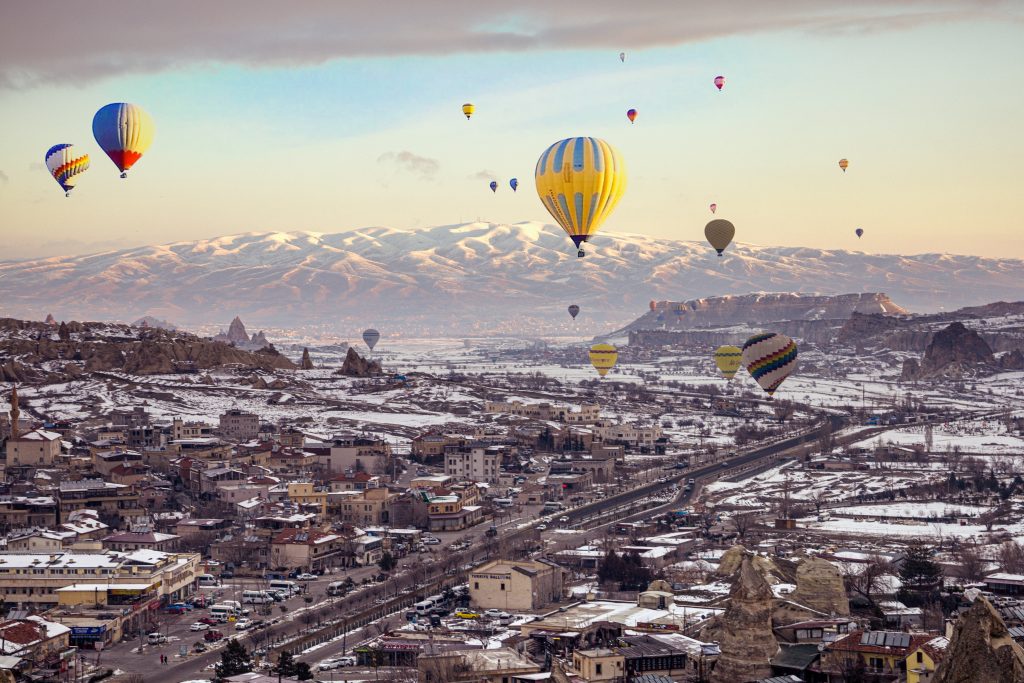
Cappadocia is a plateau plain with volcanic peaks at an altitude of a thousand meters above sea level. The highest point of Cappadocia, Mount Erciyes, with approximately 4,000 meters, makes the climate of the region continental, and the hot and dry summers make the region ideal for hiking and having a pleasant time with balloons. In Cappadocia, which is snowy and cold in winter, the snow-covered mountain peaks also give tourists the opportunity to enjoy winter sports, the most beautiful of which is skiing.
In addition to its cultural heritage, Cappadocia is one of the most suitable regions for adventure and nature tourism with its unique natural beauties. In the Cappadocia Region, the diversification of nature-based touristic products shows a continuous development. Safari tours (ATV and Jeep), horse tours, bicycle tours and hot air balloon tours are organized within the scope of adventure tourism in the region.
Hot air balloon tours have made significant contributions to the development and diversification of tourism in Cappadocia. In the last 20 years, significant investments have been made in Cappadocia that can be associated with balloon tourism. These investments have made Cappadocia the most important balloon flight center of Turkey and the world. Hot air ballooning, which gained momentum in the 1990s in the Cappadocia Region, is one of the sources of economic return with high added value in the region. Flying with hot balloons, one of the most exciting activities in Cappadocia, creates an attraction for tourists to try this incredible experience in the arms of nature, tourists take off and fly over the mountains and magnificent landscapes.
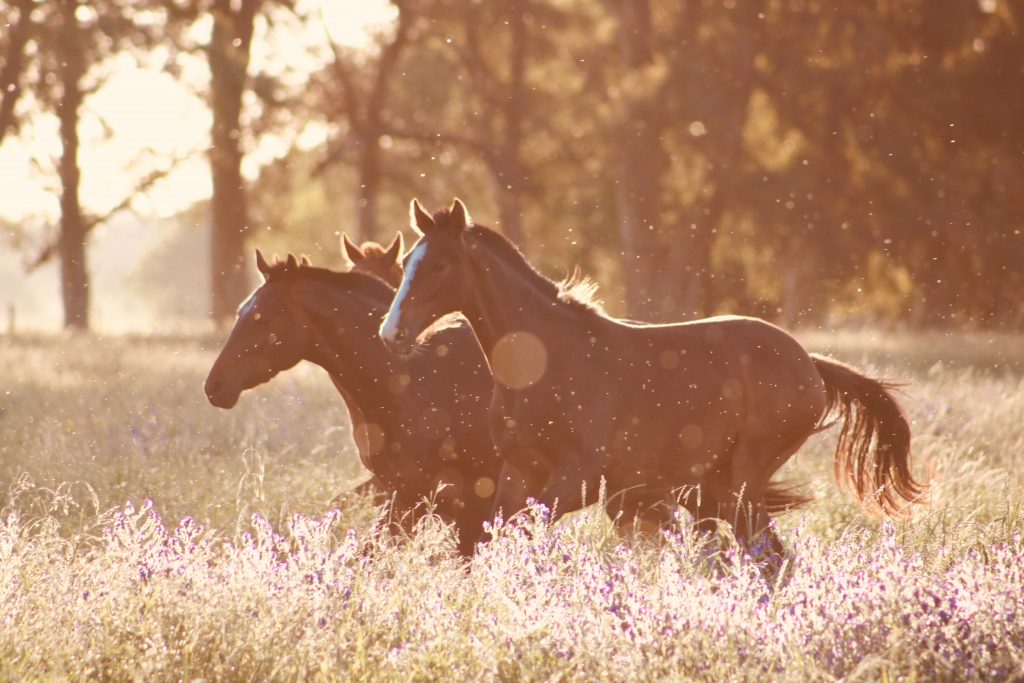
In addition to the balloon and safari experiences it offers, the Cappadocia region is one of the most special regions of Turkey in the field of equestrian, and the horse riding activity carried out within the scope of the services provided by many horse farms in the region constitutes a different alternative to discovering Cappadocia. Tour horses are trained on the farms and horse riding trainings are organized for the riders.
Cappadocia also hosts many festivals and events. In the Balloon Festival organized by Ürgüp Municipality, many singers have concerts, international painting exhibitions are held, and there are stage performances by artists from different countries of the world. In the Vintage Festival, which was held for the fiftieth in 2022, it is aimed to promote the Ürgüp grape and support its agriculture. Famous artists perform and colorful activities such as grape treats, competitions, folk dance performances, molasses making, vintage are carried out at the festival. Cycling and running race organizations by Argeus (https://argeus.com), which has been providing the highest quality and comprehensive tour organization services in the region since 1993, has made an important name in the international arena and is not limited to the region. Organizations are held with the participation of thousands of local and foreign people and provide added value to Cappadocia. 2022 Cappadocia Ultra Trail running organization were held between 14 - 16 October.
The different texture of Cappadocia has led its hotels to stand out with a different concept from other touristic resorts. There are extremely stylish hotels built inside caves, concentrated in the triangle of Ürgüp, Avanos and Göreme. Unlike the usual concept of hotels, their integration with nature by being designed inside the cave is an attractive element for travelers. Hotels usually have a fascinating terrace view, watching the sunrise from the terraces in the early morning and mixing with the colors of the sunset offer an unforgettable experience. In addition, the motifs of the old periods are reflected in the decoration, adding a museum atmosphere to the hotels. In some of the hotels, cellars where various wines produced with the grapes of the region are kept still exist.
 English
  Turkish